On this page (18 sections)
- Lawn edging: the main types
- Landscaping borders that handle limestone and clay soil
- Landscaping staples and edging anchors
- Landscaping edging near trees
- Edging and lawn care
- What edging costs
- Questions to ask before hiring
- HOA and city notes
- Installing metal edging, step by step
- Installing a paver or stone border
- The spade-cut edge routine
- Drawing edge lines that mow well
- Edging, slope and runoff
- Keeping edging in shape
- Mistakes to avoid
- Picking an edge by situation
- Where edging fits in the order of work
- Related services

Lawn edging: the main types
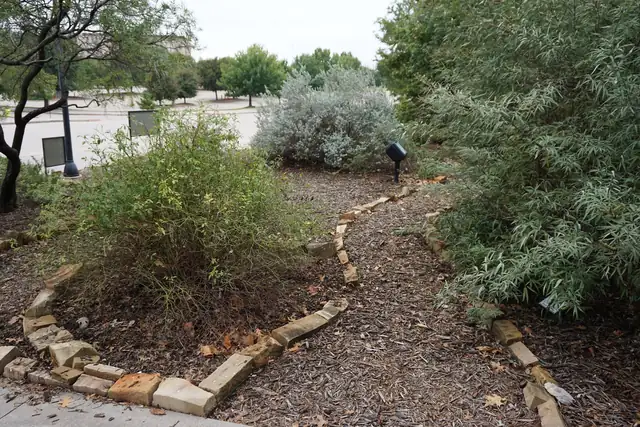
Lawn edging comes in a handful of materials. Each has trade-offs on cost, look and life span.
| Type | How it is set | Good for | Watch for |
|---|---|---|---|
| Steel or aluminum | Driven or staked into a trench | Clean curves, thin line | Hard to drive into shallow rock |
| Plastic with stakes | Staked along a trench | Low cost, quick fix | Heaves in heat, tripping |
| Poured or stamped concrete curb | Formed in place | Permanent, mower-friendly | Cracks on shifting clay |
| Stone, brick or pavers | Laid on a compacted base | Formal beds, paths | Needs a firm base |
| Spade-cut trench | Dug with a flat spade | Zero material cost | Needs yearly recutting |
Landscaping borders that handle limestone and clay soil
Soil depth matters more than style. One map unit in a Hays County soil survey is extremely stony clay with limestone 13 to 20 inches below the surface.[2] Another soil in it is clay with very slow permeability that swells and shrinks.[2] Stakes and steel can hit rock within a few inches, and clay movement pushes lightweight edging out of line.
Practical answers include setting stone or pavers on a compacted base rather than driving anchors. A concrete curb suits shrink-and-swell clay, and a shallow spade edge suits spots where rock is close to the surface. Ask the provider how deep they expect to go and what they will do if they hit rock.
Landscaping staples and edging anchors
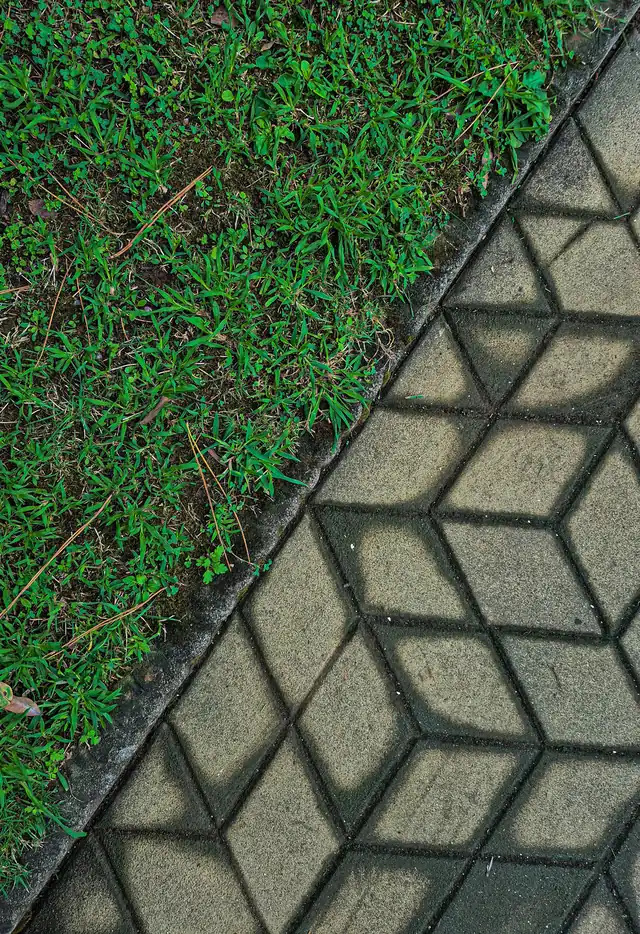
Searches for landscaping staples usually mean the U-shaped pins that hold landscape fabric or plastic edging in place. They work in soft, deep soil and fail in rocky or compacted ground. If staples keep popping up, the fix is usually longer anchors, a different edging material or a pre-drilled hole, not more staples.
Be careful with fabric under rock or mulch too. It can trap water and encourage weeds on top as debris builds up. A deeper mulch layer does more: TWDB advises three to four inches around plants and trees.[3]
Landscaping edging near trees
Don't trench through root zones. The city's tree-protection spec typically fences the outer limit of the critical root zone to guard against grade changes of more than 4 inches.[4] Cutting roots to set an edge opens wounds. Texas A&M Forest Service says any new wound on an oak can be an oak wilt entry point.[5] It advises avoiding wounding oaks from February through June.[5] For edging near an oak, use shallow, above-ground borders such as stone or paver.
Edging and lawn care
A clean edge makes mowing faster and keeps turf out of beds. Mowing height still matters: an AgriLife East Texas lawn guide lists St. Augustine at 2.5 to 4 inches and common Bermuda at 1 to 3 inches.[6] String-trimmer wounds on tree bases can be an entry point for oak wilt, so keep trimmers away from trunks.[5]
Edging also helps with water. A raised border holds mulch in place and keeps runoff from carrying it into the street, and the city counts runoff as waste.[7]
What edging costs
Pricing depends heavily on material and length. The February 2026 national cost guide lists landscape curbing at $400 to $2,200 on average, depending on style and material.[1] Those are national numbers, not local prices, and this site does not set a price. Drivers include linear feet, material, trenching depth, curves, and how much rock the installer meets. Hand labor at $50 to $100 per hour is typical nationally.[1]
Plastic is usually the cheapest to buy and the shortest-lived; poured concrete and stone usually cost more and last longer. Ask the provider for a per-foot price by material so you can compare. See the landscaping cost guide for broader context.
Questions to ask before hiring
- What material do you recommend for my soil, and why?
- How deep is the trench, and how will it be anchored?
- What happens if you hit limestone?
- Will the work cross root zones of oaks or other trees?
- Is cleanup and haul-away of excavated soil included?
Get the answers in writing. The Texas Attorney General advises getting bids from more than one contractor, in writing, with detail on what will be done.[8]
HOA and city notes
Edging is rarely regulated, but a wall or curb in a floodplain buffer can need a permit. San Marcos requires a Floodplain Permit for any building permit on a lot not fully two feet above the regulated floodplain.[9] It regulates the buffer too.[9] Check with the city before building anything solid in a low area. HOAs may have rules about visible materials, so ask before you buy.
Installing metal edging, step by step
Steel and aluminum edging make the cleanest line, but only when the trench is right. A careful installer works like this:
- Lay out the curve. A garden hose or rope on the ground shows how the line will look from the patio and the street. Move it until it looks natural.
- Mark it. Spray paint or flour along the hose gives a line to cut.
- Cut the trench. A flat spade makes a narrow, straight-sided slot. Where rock appears, stop and switch method rather than forcing the steel.
- Set the edging. Stakes go on the bed side, and the top sits just above the soil so mulch stays in without a lip that trips a mower.
- Backfill and tamp. Pack soil on both sides so the edge cannot lean.
- Join the sections. Use the connectors the maker supplies, and keep seams out of tight curves.
- Test it. Run a mower along the line. If a wheel catches, fix it now.
On this soil, ask the provider what the plan is for the first stretch of rock. A good answer names a different material, not more force.
Installing a paver or stone border
A paver or stone border is slower to build and lasts longest. The base is the job. The installer digs out the line, compacts a firm layer of crushed base and adds a thin leveling layer of sand. Each unit is set tight, and sand is swept into the joints. Done well, a mower can ride along the top and cut grass right to the edge, which removes the need to trim by hand. Done on loose soil, the units rock and open gaps within a season, so ask how deep the base goes and how it is compacted.
The spade-cut edge routine
The cheapest edge costs no material at all: a vertical cut where the lawn meets the bed. It needs a flat spade, a straight line and a little time each season. Cut a clean wall, lift out the loose strip of turf and use it to patch bare spots elsewhere. Mulch in the bed then covers the weeds that would otherwise creep in. AgriLife says mulch reduces weeds and keeps soil temperatures more moderate.[10] That makes a mulched, spade-cut bed a sound low-cost start for a yard with shallow rock.
Drawing edge lines that mow well
Shape decides how easy the lawn is to keep. Gentle curves are easy to mow, while tight scallops need a trimmer each week. Keep bed edges a mower-width from fences and walls so the machine can pass. Match the bed shape to the way the ground drains, and leave access to hose bibs, meters and cleanouts. Where a bed meets a path, a flush border lets the mower ride up and over without leaving a ragged strip.
Edging, slope and runoff
On a slope, an edge acts as a small dam that holds mulch and soil in the bed. TWDB says groundcovers on sloping sites decrease runoff,[3] so a low border plus groundcover works better than a tall wall on its own. Never build a solid border that traps water against the foundation. The city bans wasting water in every drought stage and counts runoff as waste.[7] An edge that sends irrigation water straight to the street works against you.
Keeping edging in shape
Edging is a low-maintenance feature, not a no-maintenance one. Plastic often heaves in summer heat and needs restaking in spring. Steel can lean if the soil washes away from it. Concrete may crack where clay moves, and a sealant or patch at the crack stops it growing. Stone and paver borders need their joints swept and topped up now and then. A short walk-through each spring catches most problems before the mowing season starts.
Mistakes to avoid
- Choosing edging by price per foot without asking about the soil.
- Skipping the trench and just pressing plastic into turf.
- Using staples as the only anchor in rocky ground.
- Setting the top too high, which catches mower wheels.
- Cutting roots near oaks to set a border.
- Forgetting that a visible material may need HOA approval.
Picking an edge by situation
- Rental or low-budget yard: a spade-cut edge or plain plastic with the right anchors.
- Newly mulched bed beside lawn: steel for a thin line that mulch can sit against.
- High-traffic path: stone or pavers on a compacted base.
- Clay that shrinks and swells: a rigid curb or flush paver strip, which moves less than light edging.
- Near oaks: an above-ground border that needs no trench.
Whichever you choose, ask the provider to put the material, the length and the price per foot on one page. That makes offers easy to compare.
Where edging fits in the order of work
Edging belongs after grading and before mulch or stone. If sod is going in, set the edge first so the sod butts against it. If gravel is going in, the edge holds the stone in place. Trenching is easiest when the soil is damp but not soggy, since dry clay is rock-hard and wet clay smears. Winter is often a slower season, so an edging job booked then may face a shorter wait. Ask the provider to sequence the edging with any other work in the same bed, so nobody drives a loaded wheelbarrow across a finished border.
Think about the next owner, too. A durable edge adds to the look of a yard and cuts the weekly trimming job. A flimsy one needs replacing in a couple of seasons.
Related services
Edging goes with mulch and flower bed care, rock and gravel landscaping, lawn care and mowing and landscape design. See also the questions page and the home page.
Send a request
Sources
- HomeGuide. How Much Does Landscaping Cost?, published 2026-02-04
- Texas State University (Southwest Texas State University). Soils of the Freeman Ranch, Hays County, Texas (Freeman Ranch Publication Series No. 4-2000), published 2000-07-01
- Texas Water Development Board. Texas Landscape Water Guide, accessed 2026-11-23
- City of San Marcos. Item 610S Preservation of Trees and Other Vegetation, published 2018-12-07
- Texas A&M Forest Service. Prevent the spread of oak wilt this spring in Texas, published 2022-03-29
- Texas A&M AgriLife Extension. Lawn Maintenance Guide, accessed 2026-11-23
- City of San Marcos. Water & Energy Conservation (Stage 3 watering restrictions), accessed 2026-11-23
- Office of the Texas Attorney General. How to avoid home improvement scams, accessed 2026-11-23
- City of San Marcos. FAQs, Engineering Department - Development (floodplain), accessed 2026-11-23
- Texas A&M AgriLife Extension (Texas Water Resources Institute irrigation site). E-447 Xeriscape: water-efficient landscaping, accessed 2026-11-23