On this page (12 sections)
- Drought stages, with the date each was read
- What Stage 3 allows in a San Marcos yard
- Edwards Aquifer Authority: why it matters to a yard
- TCEQ irrigator license
- Texas Department of Agriculture pesticide license
- City tree-protection specification and oak wilt
- Floodplain permits
- HOA rules and drought-resistant landscaping
- Sales tax on landscaping services
- Brush and bulk pickup
- City of San Marcos water rebates
- Where to go next
Drought stages, with the date each was read
A stage is a snapshot, not a permanent label. Every row below is dated, and each links to the official page where the live stage is posted.
| Source | Stage | As of | Where to check now |
|---|---|---|---|
| City of San Marcos | Stage 3[1] | 23 Nov 2026 | City conservation page |
| Edwards Aquifer Authority | San Antonio Pool Stage 2, 30% reduction[2] | 22 Nov 2026 | EAA drought management |
| City of Kyle | Stage 3[3] | 23 Nov 2026 | City of Kyle drought page |
| City of Buda | Stage 3 from 4 Nov 2024[4] | 4 Nov 2024 | City of Buda conservation page |
The city and the aquifer authority run separate systems. The authority's drought stages are triggered by 10-day averages of aquifer levels or springflow, and required reductions rise as levels fall.[2] Stage 1 starts when the J-17 well average drops below 660 feet, Comal Springs falls below 225 cfs or San Marcos Springs flow falls below 96 cfs. Permit holders then cut withdrawals 20 percent.[2]
On 6 November 2026 the authority said it had declared Stage 2 pumping cuts for the San Antonio Pool, effective 3 November. San Marcos Springs was at 88 cfs on a 10-day average.[5] A city can be in a different stage from the aquifer authority, so read both.
What Stage 3 allows in a San Marcos yard
The city's Stage 3 page, read 23 November 2026, lists these limits:
| Watering method | Stage 3 limit as read on 23 Nov 2026 |
|---|---|
| Hose-end sprinklers and automatic sprinkler systems | One day every other week, on the designated weekday, before 10 a.m. or after 8 p.m.[1] |
| Soaker hose and drip irrigation | One day per week on the designated weekday, before 10 a.m. or after 8 p.m.[1] |
| Foundation watering (drip, soaker or hand-held hose) | One day per week[1] |
| Hand-held hose or bucket | Any day, before 10 a.m. or after 8 p.m.[1] |
| Vegetable garden by hand, soaker hose or drip | Any day, any time[1] |
The city also publishes a monthly sprinkler calendar in Stage 3 that alternates weeks of no sprinkler use with weeks of use on the designated weekday. It bans sprinklers on weekends.[1] Stage 3 also prohibits at-home car washing, filling decorative water features and pools, and washing impervious surfaces.[1]
One detail catches new-lawn owners. Commercial nursery inventory may be watered any day at any time under Stage 3. The page lists no separate exemption for newly installed residential sod.[1] If you plan to lay sod, ask the city before you buy it. The sod installation page explains grass choices.
Waste is banned in every stage
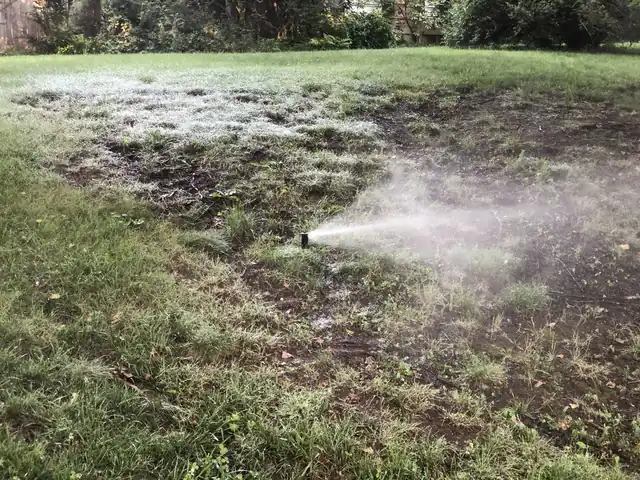
The city bans wasting water in every drought stage.[1] It defines waste to include puddling or runoff, sprinkler heads that are broken or misaligned, and failing to repair leaks.[1] That makes a quick sprinkler check part of the rules, not just good practice. The city's own tips for residents include choosing drought-resistant plants and checking and adjusting sprinkler heads.[1]
Need help sorting out Stage 3 for your yard?
Calls will be recorded.

Edwards Aquifer Authority: why it matters to a yard
The aquifer feeds San Marcos Springs. The springs' flow is one of the numbers the authority watches. When flow drops, pumping limits tighten and cities that depend on the water tighten outdoor use. Irrigation is optional use, so it is restricted first. For the live reading, use the authority's drought management page, which showed Stage 2 on 22 November 2026.[2]
TCEQ irrigator license
Texas Occupations Code 1903.251 requires a state license to sell, design, install, maintain, alter, repair or service an irrigation system.[6] The license is also required to connect an irrigation system to any water supply. That covers tying a sprinkler or drip system into the house line.[6] Installing an irrigation system without one is a Class C misdemeanor.[6]
Key points from the Texas Commission on Environmental Quality's rule compilation (RG-470, February 2021):
- A property owner doing irrigation work on his or her own home premises is exempt.[6]
- A gardener or lawn caretaker is exempt only for sprinkler work on land the person owns, not for hire on customers' property.[6]
- A written installation contract must be signed by both sides and show the irrigator's name, license number and total price.[6]
- Every new automatic system needs a rain or moisture sensor or equivalent technology, and so does a replacement controller.[6]
- The irrigator must give the owner a written warranty covering materials and labor on a new installation.[6]
- Contracts must carry a notice that irrigation is regulated by TCEQ, with a place to complain.[6]
TCEQ runs a public search for licensed irrigators and a complaint process, on its landscape irrigation page.[7] Complaints against an unlicensed irrigator can also be filed in municipal and justice courts, and an officer can issue a ticket under Sec. 1903.256.[7] If fertilizer or other chemicals are injected into an irrigation system, TCEQ requires a reduced pressure backflow assembly.[7] Texas rules also require every advertisement for irrigation services to show the licensed irrigator's license number. The ad must also show the irrigator's name when it shows any other name.[6] This site is not run by a licensed irrigator, so it does not arrange, price or advertise irrigation work. If you want irrigation work done, use TCEQ's search to find a licensed irrigator.
Texas Department of Agriculture pesticide license
Applying any pesticide to lawns, trees, ornamentals or weeds for hire requires a Texas Department of Agriculture license.[8] Applicators who only apply fertilizer do not need a TDA license.[8] Landscape applicators certify in the 3A Landscape Maintenance and/or 5 Vegetation Management category under the Ag Pest license. Vehicles of Ag Pest 3A applicator businesses must display a TDA applicator vehicle decal.[8]
That means a mowing provider who also sprays weed killer needs the license for the spraying. This site does not arrange pesticide, herbicide or weed-control work; if you hire anyone for it, ask to see the license. TDA explains the license on its lawn, tree and ornamental pesticide page. The lawn care page covers what a service visit should include.
City tree-protection specification and oak wilt
San Marcos adopted its tree-protection spec, Item 610S, on 1 January 2020. It covers trees near permitted development and requires a qualified arborist to supervise pruning.[9] Read it in the city's Item 610S document. Its main points:
- Protective fences typically go at the outer limit of the critical root zone, to prevent compaction and grade changes greater than 4 inches.[9]
- Type A fencing is at least five-foot chain link with steel or T-post supports.[9]
- Where fencing is built closer to construction, organic mulch goes 8 inches deep in unprotected root zone areas.[9]
- Damage to oaks must be treated immediately to reduce oak wilt risk.[9]
- Tree removal is cut to at most 12 inches below grade, with hand saws where roots of preserved trees are present.[9]
- February through June is the high-risk period for oak wilt.[9]
The Texas A&M Forest Service gives the same advice for homeowners: avoid pruning or wounding oaks from February through June.[10] Details are in its oak wilt guidance. See tree and shrub planting for more.
Floodplain permits
San Marcos requires a Floodplain Permit for any building permit on a lot not fully two feet above the regulated floodplain.[11] The city also regulates a floodplain buffer zone, the extra area that would flood if the floodplain rose two feet.[11] The City Floodplain Administrator in Engineering can tell an owner whether a lot lies in the buffer.[11]
The city does not itself require flood insurance, but mortgages do if the structure is in a regulated floodplain.[11] Ask the city whether a patio, retaining wall or grading project near a creek triggers a permit. The city's floodplain FAQ is the starting point.
HOA rules and drought-resistant landscaping
Texas Property Code 202.007 voids HOA rules that prohibit drought-resistant landscaping or water-conserving natural turf.[12] The same law protects rain barrels and efficient irrigation, including drip systems, from HOA bans.[12] It also protects composting and leaving grass clippings on the lawn.[12]
There are limits. An HOA may still require a plan for review so the landscaping looks compatible with the rest of the subdivision. It may not unreasonably deny the plan.[12] An HOA may restrict the type of turf in new planting to require water-conserving turf.[12] Read the statute at Texas Property Code 202.007. The xeriscaping page explains what a drought-wise plan can look like.
Sales tax on landscaping services
Texas treats landscaping and the care and maintenance of lawns, yards, ornamental trees and plants as taxable real property services.[13][14] The Tax Code excludes these services when a contractor buys them as part of improving real property with a new residence.[13] The statute is at Tax Code 151.0048. Ask any provider whether tax is on the written price. For the state's current rate and guidance, use the Texas Comptroller.
Brush and bulk pickup
San Marcos garbage customers get a green-waste cart, and loose yard waste goes in the cart with no plastic bags.[15] It is serviced every other week depending on the route.[15] When it is full, the city allows up to 12 extra paper bags of yard waste beside it on service day.[15]
Bulk pickup works differently:
- Residential garbage customers get four bulk pick-ups a year, each limited to 3 cubic yards, and all bulk items go to the landfill.[15]
- Requests must be confirmed by 3 p.m. two business days before the garbage service day.[15]
- Bulk brush must be no longer than 4 feet, each piece under 5 inches in diameter, bundled and tied, and no more than 35 pounds.[16]
Two drop-off options exist. The monthly brush drop-off on the second Saturday of each month is open to residential garbage customers, and the material is mulched.[17] It runs 8 a.m. to 1 p.m. at 750 River Road, and the last two dates listed for 2026 were 14 November and 12 December.[17] It does not take soil, dirt, sod, treated lumber, or yard waste in paper or plastic bags.[17] Commercial material is not accepted, so a hired crew cannot use it for your yard.[17]
Residential garbage customers may also take up to 5 cubic yards of brush a month to the city-listed brush drop-off site in Creedmoor at no added charge. Cover the load with a tarp to avoid extra disposal fees, and bring a driver's license and a utility bill to show.[18] Official pages: curbside services and the monthly brush event. The yard cleanup page shows how this fits a cleanup job.
City of San Marcos water rebates
San Marcos offers several water rebates, listed on the city's rebate page:
- The city's Soil Saver rebate, a rebate for core aeration and compost top-dressing of lawn areas.[19]
- The city's rebate for converting spray zones to drip irrigation or point-source emitters.[19] The program requires the work to be done by a Texas licensed irrigator or by the property owner.[19]
- The city's rebates for small and large rainwater systems, where pre-approval may be needed.[19]
Apply before you buy or hire, since pre-approval rules can change. The independent provider you hire handles the work; this site does not process rebates.
Where to go next
For prices, see the landscaping cost page. For short answers, see the questions page. To see every service, return to the home page.
Send a request
Sources
- City of San Marcos. Water & Energy Conservation (Stage 3 watering restrictions), accessed 2026-11-23
- Edwards Aquifer Authority. Critical Period/Drought Management (CPM), published 2026-11-22
- City of Kyle. Current Drought Stage & Watering Restrictions, accessed 2026-11-23
- City of Buda. Water Conservation, published 2024-11-04
- Edwards Aquifer Authority. Press release: Recent rains improve aquifer levels and prompt return to EAA Stage 2 (Nov 6, 2026), published 2026-11-06
- Texas Commission on Environmental Quality. RG-470 Landscape Irrigator's Rule Compilation (Feb 2021), published 2021-02-01
- Texas Commission on Environmental Quality. Landscape Irrigation, accessed 2026-11-23
- Texas Department of Agriculture. Applying Pesticides to Ornamentals, Trees, Lawns, or Weeds, accessed 2026-11-23
- City of San Marcos. Item 610S Preservation of Trees and Other Vegetation, published 2018-12-07
- Texas A&M Forest Service. Prevent the spread of oak wilt this spring in Texas, published 2022-03-29
- City of San Marcos. FAQs, Engineering Department - Development (floodplain), accessed 2026-11-23
- Texas Legislative Council (Texas Constitution and Statutes). Tex. Prop. Code Sec. 202.007 Certain Restrictive Covenants Prohibited, accessed 2026-11-23
- Texas Legislative Council (Texas Constitution and Statutes). Tex. Tax Code Sec. 151.0048 Real Property Service, accessed 2026-11-23
- Legal Information Institute, Cornell Law School (Texas Comptroller rule). 34 Tex. Admin. Code 3.356 - Real Property Service, accessed 2026-11-23
- City of San Marcos. Residential Curbside Services, accessed 2026-11-23
- City of San Marcos. Bulk Waste Pick-Up form, accessed 2026-11-23
- City of San Marcos. San Marcos Monthly Brush Drop-Off Event, accessed 2026-11-23
- City of San Marcos. Texas Disposal Systems Brush Drop-Off, accessed 2026-11-23
- City of San Marcos. Water Rebate Programs, accessed 2026-11-23