On this page (18 sections)
- Where gravel works and where it does not
- Black gravel landscaping and other colors
- Preparation decides how it lasts
- Gravel, mulch and weeds
- Gravel near trees
- Gravel and drought rules
- Hauling and disposal
- What gravel landscaping costs
- Questions to ask the provider
- Choosing stone by size, shape and job
- Ordering the right amount
- Dry creek beds and drainage
- Keeping weeds out without fabric
- Heat, plants and color
- Building a gravel path
- Maintaining a gravel yard
- Mistakes to avoid
- Related services

Where gravel works and where it does not
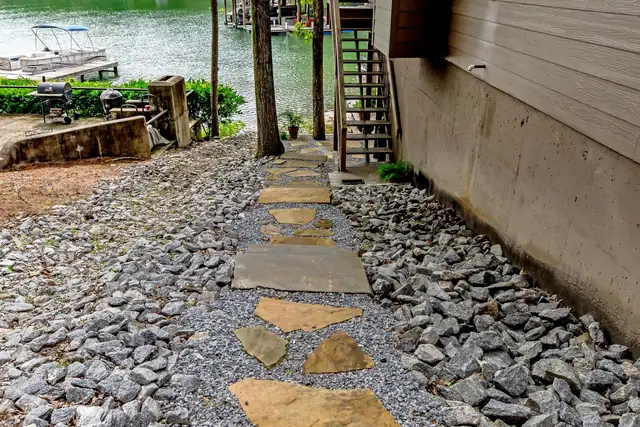
Gravel suits paths, dry creek beds, drive edges, side yards and xeriscape beds. It drains well, never needs mowing and does not blow away like mulch. It does not suit everything.
- Good: paths, bed borders, areas under drought-tolerant plants, low-traffic side yards.
- Poor: under oaks if it buries roots, sloped ground that washes, and spots where leaves and debris fall heavily.
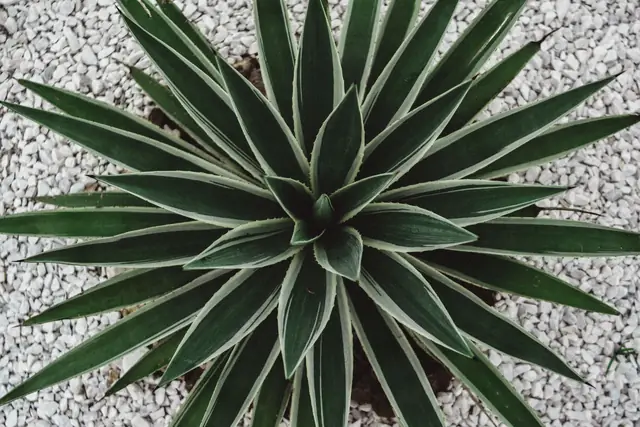
Stone also absorbs and gives off heat. NOAA normals show 21.4 days a year at 100 F or more.[3] Rock beds next to a wall can run hot enough to scorch tender plants. Choose plants that tolerate reflected heat, such as agave-type plants and native grasses.
Thinking about replacing lawn or mulch with stone?
Calls will be recorded.
Black gravel landscaping and other colors
Black gravel landscaping looks sharp against light stucco and green plants. But dark stone gets hotter in summer sun than light stone. In a bed with sensitive plants, a lighter tan or gray rock is a safer pick. Stone color should be matched to the house and the HOA's rules, not just taste.
A national price guide lists these common choices.
- Crushed stone or gravel: $10 to $50 per ton, $15 to $75 per yard, or $1 to $3 per square foot at 12 inches deep (December 2025).[2]
- River rock: $45 to $130 per ton or $50 to $160 per yard, with typical rock projects of $250 to $1,500.[4]
- Decomposed granite: $40 to $100 per yard natural, $100 to $225 stabilized (July 2024).[5]
These are national figures, not local quotes. Decomposed granite compacts into a firm path surface, while loose gravel shifts underfoot.
Preparation decides how it lasts
Good gravel jobs follow a sequence:
- Remove sod or weeds and grade for drainage away from the house.
- Set edging to hold the stone in.
- Lay a base layer where a path or drive edge needs firmness.
- Place the stone at a depth matched to the traffic, deeper where it will be walked or driven on.
- Plant first or plant through the stone.
Local soil adds a twist. A Hays County soil survey describes a stony clay map unit with limestone close to the surface.[6] Another clay soil in it drains very slowly and swells and shrinks.[6] In clay, gravel can sink and mix with soil over time unless there is a firm base. See edging and bed borders for ways to contain it.
Fabric or no fabric
Landscape fabric under gravel is common but has downsides. Soil and debris build up on top, weeds root in that layer and the fabric blocks the soil from feeding plants. Many designers now skip fabric in planted beds and use a deeper stone layer instead. Ask the provider what they plan and why.
Gravel, mulch and weeds
TWDB says mulch cuts evaporation, evens soil temperature and reduces weeds, and organic mulch enriches the soil.[7] Stone does some of this but does not feed the soil. Where you have plants that need soil improvement, organic mulch may be a better choice; see mulch and flower bed care.
Gravel near trees
Don't pile stone on top of roots. The city's tree-protection spec guards the critical root zone against grade changes of more than 4 inches.[8] A thick rock layer raises grade and can smother roots. If you need gravel near an oak, keep the layer thin and the area outside the critical root zone.
Gravel and drought rules
Hardscape reduces the area that needs watering, which helps under Stage 3. As of 2026-11-23, drip and soaker lines run one day per week.[1] Texas law also voids HOA rules that prohibit drought-resistant landscaping, though an HOA may still review the plan.[9] Read xeriscaping for the full water-wise approach.
Hauling and disposal
If a project removes lawn, sod and soil must go somewhere. The city's brush drop-off does not take soil, dirt, sod or treated lumber.[10] It does not accept commercial material either, so a hired crew cannot use it for customer yards.[10] Ask who hauls waste and where it goes.
What gravel landscaping costs
Total price is rarely just stone. The same guide puts typical rock-landscaping projects at $250 to $1,500 nationally.[4] Delivery, grading, edging, hand labor and haul-away raise it. General landscaping labor runs $50 to $100 per hour in national data.[11] Weight matters: that guide says one cubic yard contains 1.4 to 1.5 tons of stone,[2] so access and delivery can add cost.
Questions to ask the provider
- What stone, what color and what depth?
- What base layer and edging will hold it?
- Will fabric be used, and why?
- How will plants be watered, and who installs any irrigation? Texas requires a license for irrigation work done for hire.[12]
- Who hauls away the removed sod and soil?
Choosing stone by size, shape and job
Stone is sold by type and size, and the wrong pick shows up underfoot. Rounded pea gravel and river rock roll and shift, which looks soft in a bed but is tiring on a path. Crushed, angular stone knits together and packs firm. Decomposed granite fines compact into a smooth surface for paths and seating areas, and a stabilized version resists washing out. Large cobbles suit dry creek beds and borders, and flat flagstone suits stepping stones.
Ask the provider for a sample of the actual material in sun and in shade, because wet stone and dry stone look different. Also ask whether the stone is washed. Dusty fines blow around and cloud a bed for weeks after the job.
Ordering the right amount
Stone is priced by the ton or the cubic yard, and the two do not convert one-to-one. A national guide says a cubic yard holds 1.4 to 1.5 tons of stone.[2] So a quote in tons and a quote in yards can look far apart. To estimate volume, multiply length by width by depth in feet, then divide by 27 to get cubic yards. Ask the provider to show that arithmetic, and to say how much they add for settling and waste. Ordering a little over is cheap; a second delivery is not.
Dry creek beds and drainage
A dry creek bed is a shaped channel of river rock that carries runoff during storms. The rest of the time it looks like a stream bed. It works best along a natural low line, not as a decoration on flat ground. The soil under it matters. A Hays County soil survey describes one limestone-based soil as well drained but limited in how much moisture it can hold.[6] It describes another clay soil as very slowly permeable.[6] On clay, a channel needs somewhere for water to go, and it should never push water onto a neighbor's lot.
If the channel sits near a creek or low area, ask whether the lot lies in the city's floodplain buffer.[13] Building work on a low lot can need a Floodplain Permit.[13] The Floodplain Administrator can say what applies to your lot, so ask before any heavy digging.
Keeping weeds out without fabric
Many weeds root in the layer of dust, leaves and seed on top of the stone. Those do not root in the soil beneath it. That is why fabric often fails over time. A better defense is a deep enough stone layer, a firm edge and regular clearing of debris. AgriLife lists lava rock and limestone among inorganic mulches, which reduce weeds and keep soil temperatures more even.[14] A leaf blower on low or a stiff rake once a month in fall keeps leaves from turning into a seed bed. Pull the few weeds that appear by hand while they are small.
Heat, plants and color
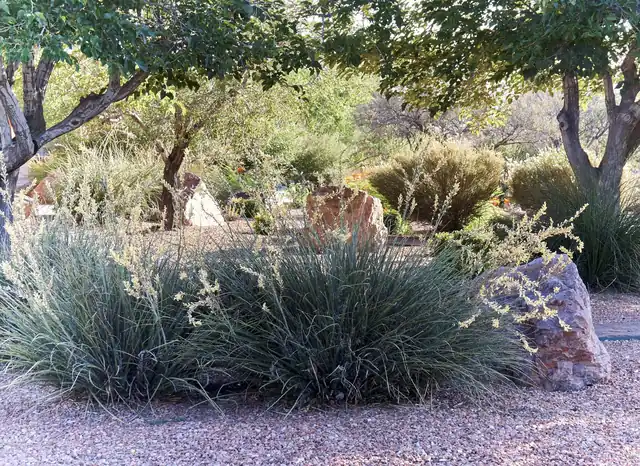
Stone soaks up sun and gives it back. Plants beside a wall or a dark bed face more heat than the air temperature suggests. Pick plants that handle it. AgriLife describes blackfoot daisy as a maintenance-free native that resists disease and pests and needs almost no water.[15] Give each plant room to reach mature size, and keep stone from piling against stems. Light-colored stone reflects more heat toward plants, while dark stone absorbs it and warms the soil. Test a small patch before you commit to a whole bed.
Building a gravel path
A path is the most demanding use. The installer marks the line, digs out the top layer, compacts a base of crushed stone, adds the surface layer and compacts again. Edging holds it in. The base, not the surface, stops ruts and puddles, so ask what is under the visible stone. For a path that crosses a slope, ask how water will cross it rather than wash it away.
Maintaining a gravel yard
Gravel is low-maintenance, not no-maintenance. Rake it level after storms, top it up where traffic thins it, blow leaves off the surface and re-set edging that has shifted. In clay, stone slowly sinks and mixes with soil, so a thin top-up every few years keeps the surface looking fresh. A provider can offer a yearly visit for this work.
Mistakes to avoid
- Ordering by the pallet or bag without working out the yardage.
- Skipping the base on a path or drive edge.
- Using fabric as the only weed plan.
- Piling stone against a wall or the base of a tree.
- Choosing dark stone for a bed full of tender plants.
- Failing to call utility locators before digging.
If you rent your home, ask your landlord first. A stone bed is harder to undo than a mulch bed.
Related services
Gravel pairs well with xeriscaping, landscape edging, and landscape design. The cost guide, local rules and home page have more.
Send a request
Sources
- City of San Marcos. Water & Energy Conservation (Stage 3 watering restrictions), accessed 2026-11-23
- HomeGuide. How Much Does Crushed Stone or Gravel Cost?, published 2025-12-19
- NOAA National Centers for Environmental Information. 1991-2020 U.S. Climate Normals, annual/seasonal, San Marcos TX (USC00417983), accessed 2026-11-23
- HomeGuide. How Much Do Landscaping River Rocks and Stones Cost?, published 2025-12-19
- HomeGuide. How Much Does Decomposed Granite Cost?, published 2024-07-30
- Texas State University (Southwest Texas State University). Soils of the Freeman Ranch, Hays County, Texas (Freeman Ranch Publication Series No. 4-2000), published 2000-07-01
- Texas Water Development Board. Texas Landscape Water Guide, accessed 2026-11-23
- City of San Marcos. Item 610S Preservation of Trees and Other Vegetation, published 2018-12-07
- Texas Legislative Council (Texas Constitution and Statutes). Tex. Prop. Code Sec. 202.007 Certain Restrictive Covenants Prohibited, accessed 2026-11-23
- City of San Marcos. San Marcos Monthly Brush Drop-Off Event, accessed 2026-11-23
- HomeGuide. How Much Does Landscaping Cost?, published 2026-02-04
- Texas Commission on Environmental Quality. RG-470 Landscape Irrigator's Rule Compilation (Feb 2021), published 2021-02-01
- City of San Marcos. FAQs, Engineering Department - Development (floodplain), accessed 2026-11-23
- Texas A&M AgriLife Extension (Texas Water Resources Institute irrigation site). E-447 Xeriscape: water-efficient landscaping, accessed 2026-11-23
- Texas A&M AgriLife Extension. Native plants for Edwards Plateau landscapes, published 2023-03-01