On this page (16 sections)
- Lawn care near me: what the service includes
- Mowing height by grass type
- Watering rules shape the schedule
- Fertilizing and weed control: two different rules
- Seasonal lawn calendar
- What lawn care costs
- The city's Soil Saver rebate
- Grass clippings and HOA rules
- Mowing, step by step
- Reading the lawn: when it needs water
- Fertilizer timing for Central Texas lawns
- Aeration, thatch and compost
- Mistakes that cost lawns
- Winter and dormant lawns
- What to put in the service agreement
- Related services
A hired provider can run all three on a schedule.


Lawn care near me: what the service includes
Searches for lawn care near me turn up everything from a one-person mowing route to full-service companies. This page is general information, and the operator of this site does no lawn work. VVDH designs and maintains it. Typical scopes include:
- Mowing and edging on a weekly or every-other-week rhythm during the growing season.
- Trimming and blowing hard surfaces after each cut.
- Fertilizing on a seasonal plan.
- Aeration and top-dressing once a year.
Lawn care companies near me vary in what they bundle, so ask for the scope in writing: which visits, which weeks, and what is extra.
Mowing height by grass type
Cutting too short is the most common mistake. The AgriLife East Texas guide's chart lists these heights:
| Grass | Range | Optimal |
|---|---|---|
| St. Augustinegrass | 2.5 to 4 in | 2.5 in |
| Common bermudagrass | 1 to 3 in | 1.5 in |
| Hybrid bermudagrass | 0.75 to 2 in | 1 in |
Zoysia depends on type: Z. japonica runs 1 to 2 inches, while fine-bladed Z. matrella types stay at 1 inch or less.[3] Ask the provider which blade height they set, and whether they sharpen blades. Shaded St. Augustine lawns usually need the taller end.
Watering rules shape the schedule
A drought stage is a watering-limit level that tightens as aquifer or lake levels drop. As of November 2026, the city says it is in Stage 3. Sprinklers run one day every other week, before 10 a.m. or after 8 p.m. on the designated weekday.[2] Soaker or drip lines get one day per week.[2] Hand-held hose watering is allowed any day, before 10 a.m. or after 8 p.m.[2] Stages change, so check the local rules page before relying on this.
An AgriLife lawn calendar written for East Texas says to soak to a depth of four inches rather than watering a little every day.[1] Waste is banned at every stage, and the city counts runoff, misaligned heads and unrepaired leaks as waste.[2]
Fertilizing and weed control: two different rules
AgriLife says to test lawn soil every two to three years.[4] Choose fertilizer from the results rather than habit.[4] With no test, it suggests a ratio of four to six parts nitrogen, one part phosphorus and two to four parts potassium.[4] TWDB calls a soil test the number one key to establishing and maintaining landscape plants.[5]
Texas treats chemicals differently from fertilizer. Anyone who applies a pesticide or herbicide to lawns, trees, ornamentals or weeds for hire needs a Texas Department of Agriculture license.[6] Applicators who only spread fertilizer do not.[6] This site does not arrange weed control or other pesticide work. If you hire anyone for it, ask for the Texas Department of Agriculture license number. Licensed 3A applicator businesses must also display a vehicle decal.[6]
Seasonal lawn calendar
NOAA normals count about 2,974 growing degree days a year, so grass grows hard from late spring through early fall.[7] Warm-season lawns turn straw-colored at the first frost and may go dormant in winter.[3] A rough year looks like this:
- Late winter: soil test, first light mow, check for leaks.
- Spring: weekly mowing as growth picks up, fertilizer based on the test.
- Summer: deep, infrequent watering within the city limits, with mowing at the tall end.
- Early fall: aeration, and overseeding of ryegrass into bermudagrass in late September and October if you want winter color.[3]
- Winter: fewer visits, leaf removal, planning.

What lawn care costs
These are national numbers, not local prices. One national cost guide (February 2026) lists mowing a 1/8 to 1/4 acre lawn at $30 to $85 per visit.[8] It lists full-service lawn care for the same size at $100 to $400 a month.[8] It also gives $40 to $80 an hour for yard-work labor.[8] Another page from the same publisher, dated April 2023, puts mowing at $60 to $150 per acre.[9]
Price depends on lot size, slope, gates, frequency, how overgrown the lawn is and what the visit includes. A flat quarter-acre in a subdivision costs less to mow than a sloped lot with fences. See the landscaping cost guide for context on other jobs.
Lawn care prices: how to compare
When you compare prices from lawn care companies, make sure each includes the same things. Ask whether the price covers edging, blowing, bagging and trash removal. Also ask how skipped weeks during drought dormancy are handled, and whether fuel or disposal is extra. Request the terms in writing before the first visit.
The city's Soil Saver rebate
San Marcos runs a Soil Saver rebate for core aeration and compost top-dressing of lawn areas.[10] Rebate programs change and may need pre-approval, so check the city's conservation page before you book the work. That makes aeration, normally a once-a-year job, cheaper for qualifying lawns.
Grass clippings and HOA rules
Texas law protects leaving grass clippings on the lawn from HOA bans, so mulching mowers are fine under most covenants.[11] Clippings returned to the lawn feed it, which cuts both fertilizer and disposal.
Mowing, step by step
Mowing looks simple, yet most lawn damage starts at the mower. A careful provider follows a routine like this:
- Set the deck for the grass. Use the height chart above, not a single setting for every yard.
- Mow when the grass is dry. Wet blades clump, tear and leave ruts.
- Take off no more than a third of the blade at once. TWDB says never to remove more than one-third of the grass blade on any turfgrass.[5] If the lawn got ahead of you, cut in two stages a few days apart.
- Keep blades sharp. The AgriLife East Texas calendar says a dull blade injures the grass and leaves a rough-cut lawn.[1]
- Raise the deck in summer. The same calendar says to raise the mower height during the hot summer months.[1]
- Leave the clippings. They return nutrients, and the HOA rule above protects the practice.
- Blow clippings off hard surfaces. Clippings on pavement wash into storm drains.
Ask the provider whether the price assumes a fixed day each week or a flexible schedule. Wet weeks and fast growth shift both.
Reading the lawn: when it needs water
Watch the grass instead of the calendar. TWDB says turf takes on a dull, dark look and its blades begin to roll when it needs water.[5] AgriLife's Xeriscape guide adds that at the first sign of wilting a lawn has 24 to 48 hours to be watered before serious injury occurs.[12]
How much water is enough? TWDB says healthy, properly irrigated summer turf rarely needs more than 1 inch per week. It adds that winter watering is rarely needed except in a long dry spell.[5] AgriLife says most lawns receive twice what they need.[12] A simple check is to wet the soil 4 to 6 inches deep and probe with a screwdriver to see where the damp ends.[5]
Timing matters for disease. The East Texas calendar says to water early in the morning, not at night, to cut down on possible lawn fungus problems.[1] San Marcos limits when sprinklers may run, so read the local rules page before you set a schedule.
Fertilizer timing for Central Texas lawns
Fertilizer is a timing job. AgriLife's checklist says to make the first spring application after the second mowing of lawn grass, not weeds.[4] It says to split annual nitrogen into single applications of 1 pound of nitrogen or less per 1,000 square feet.[4] Space any extra applications between spring and fall at least 45 to 60 days apart.[4]
The last feeding of the year has a cut-off. AgriLife says the final late-season nitrogen should go on no later than 6 weeks before the expected autumn frost.[4] Its frost table lists Austin and San Antonio with an average first autumn frost of December 1 and an October 15 nitrogen deadline.[4] San Marcos is not in that table, but it lies between those two cities, so their row is the closest guide. The East Texas calendar adds that a fall feeding improves winter hardiness and speeds spring green-up.[1]
Ask any provider who fertilizes for the product, the rate and the dates, and compare them with the soil test.
Aeration, thatch and compost
Compacted soil is common under busy lawns and in clay. Core aeration pulls small plugs of soil so air, water and roots can move, and topdressing with compost afterward feeds the lawn. Many owners aerate once a year in the growing season. If the city's Soil Saver program covers the work, get its approval steps before booking. A provider should be able to say how many passes they make and whether they mark sprinkler heads and shallow lines first.
Mistakes that cost lawns
- Scalping the lawn to "save" a visit, which stresses roots and invites weeds.
- Watering a little every day, which keeps roots shallow.
- Feeding in a drought or just before a freeze.
- Mowing wet grass with a dull blade.
- Letting runoff run down the street, which counts as waste under the city's rules.[2]
- Paying for spraying without checking the applicator's state license.[6]
Winter and dormant lawns
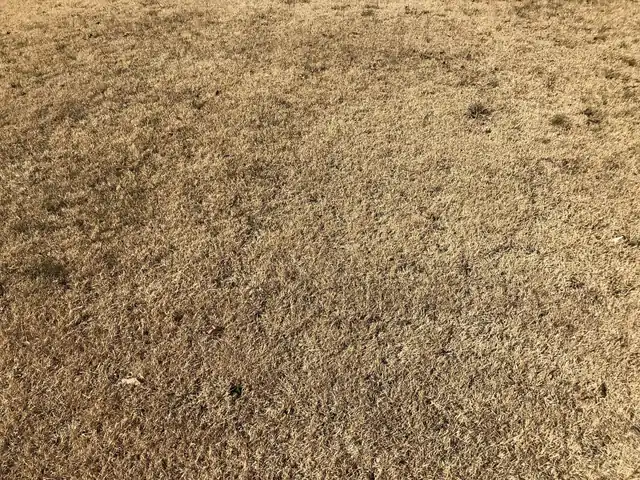
A tan lawn in January is not a dead lawn. Warm-season turf goes dormant after frost, so mowing visits thin out and watering is rarely needed.[3][5] Winter is the time to sharpen blades, plan any aeration or sod repairs, and send a soil sample. Ask your provider whether the monthly price pauses in winter or stays flat all year, because the answer changes the yearly total.
What to put in the service agreement
Put the scope in writing first.
- Visit frequency, the day of the week and what happens in a rain week.
- The mowing height for your grass and who sets it.
- Edging, trimming, blowing and trash removal: included or extra.
- Fertilizing: product, rate and dates, or none.
- How skipped visits during dormancy or drought are billed.
- How to end the service and with how much notice.
Texas treats lawn care as a taxable real property service, so ask whether tax appears on each invoice.[13][14] The Texas Attorney General also advises getting a written bid from more than one contractor, with detail on what will be done.[15]
Related services
Lawn care often goes together with sod installation, edging and bed borders and mulch and flower bed care. For more, see the landscaping guides, the questions page or the home page.
Send a request
Sources
- Texas A&M AgriLife Extension. Lawn Maintenance Guide, accessed 2026-11-23
- City of San Marcos. Water & Energy Conservation (Stage 3 watering restrictions), accessed 2026-11-23
- Texas A&M AgriLife Extension. Turfgrass Selection for Texas (L-5519), published 2010-06-01
- Texas A&M AgriLife Extension. E-436 Fertilizing Texas Lawns: 10-Point Checklist for Warm-Season Grasses, published 2007-01-01
- Texas Water Development Board. Texas Landscape Water Guide, accessed 2026-11-23
- Texas Department of Agriculture. Applying Pesticides to Ornamentals, Trees, Lawns, or Weeds, accessed 2026-11-23
- NOAA National Centers for Environmental Information. 1991-2020 U.S. Climate Normals, annual/seasonal, San Marcos TX (USC00417983), accessed 2026-11-23
- HomeGuide. How Much Does Lawn Care Cost?, published 2026-02-04
- HomeGuide. Lawn Mowing Cost, published 2023-04-05
- City of San Marcos. Water Rebate Programs, accessed 2026-11-23
- Texas Legislative Council (Texas Constitution and Statutes). Tex. Prop. Code Sec. 202.007 Certain Restrictive Covenants Prohibited, accessed 2026-11-23
- Texas A&M AgriLife Extension (Texas Water Resources Institute irrigation site). E-447 Xeriscape: water-efficient landscaping, accessed 2026-11-23
- Texas Legislative Council (Texas Constitution and Statutes). Tex. Tax Code Sec. 151.0048 Real Property Service, accessed 2026-11-23
- Legal Information Institute, Cornell Law School (Texas Comptroller rule). 34 Tex. Admin. Code 3.356 - Real Property Service, accessed 2026-11-23
- Office of the Texas Attorney General. How to avoid home improvement scams, accessed 2026-11-23