On this page (17 sections)
- The seven principles behind a xeriscape
- Why it fits this part of Texas
- Plants, rock and mulch
- Keep some lawn, and water it smartly
- Irrigation in a xeriscape
- HOA and city rules
- What xeriscaping costs
- Questions to ask the provider
- Building a xeriscape in phases
- Shrinking the lawn without losing the yard
- The water numbers behind the idea
- Group plants by thirst
- Mulch and stone choices
- Plants that look the part
- Mistakes that undo a xeriscape
- Care in the first two years and after
- Related services

The seven principles behind a xeriscape
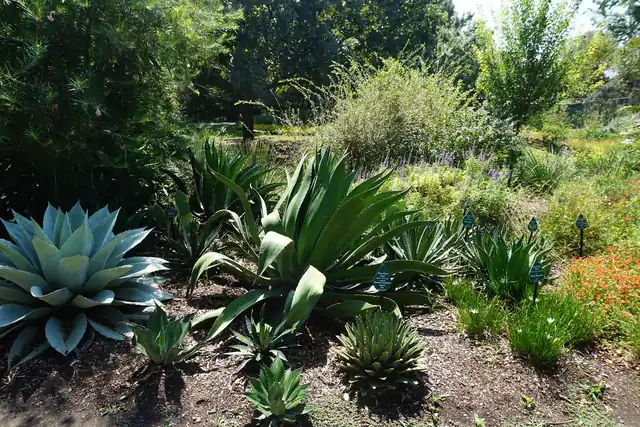
AgriLife publication E-447 lists seven Xeriscape principles, and a sound project follows them:[3]
- Planning and design. Draw the yard, group by water need.
- Soil analysis. Test before you amend.
- Practical turf. Keep lawn only where it earns its water.
- Plant selection. Choose for local soil and climate.
- Efficient irrigation. Drip where possible.
- Mulch. Cover bare soil.
- Maintenance. Prune, weed and check water lines.
Many people think xeriscaping means cactus and gravel. In practice it is a plan that matches plants to rainfall and soil.
Why it fits this part of Texas
The NOAA 1991-2020 normals put annual rainfall near 36.55 inches, yet the spread is lopsided.[4] May is the wettest month at 4.53 inches, and July falls to 2.21.[5] Triple-digit afternoons arrive on 21.4 days in a typical year.[4] Rain comes in bursts followed by long dry spells, so plants that tolerate both do best. ZIP 78666 sits in hardiness zone 9a on a USDA-based lookup.[6]
AgriLife points out that the greatest water waste in a landscape is applying too much too often.[3] A xeriscape cuts that problem at its source.
Soil first
A Texas State University survey of a Hays County ranch describes the plateau's soils as stony, with limestone below.[7] If your lot is heavy clay instead, AgriLife suggests a berm or raised bed of sandy soil. The guide calls for only a little organic matter in that soil, for a rock-loving perennial.[8] A soil test through the county Extension office or the Texas A&M lab shows what the bed needs before you buy plants.[9]
Plants, rock and mulch
Texas mountain laurel usually grows 10 to 15 feet tall as an evergreen shrub or small tree.[8] Native grasses and wildflowers include sideoats and blue grama, little bluestem, Lindheimer muhly, Texas bluebonnet and Indian blanket.[8] See native plant landscaping for more.
Rock and gravel beds are common in xeriscapes, but they work best as part of the plan. Read about gravel landscaping before replacing a lawn with stone. Mulch matters too: TWDB advises three to four inches around plants and trees, and says it cuts evaporation, evens soil temperature and reduces weeds.[10]
Keep some lawn, and water it smartly
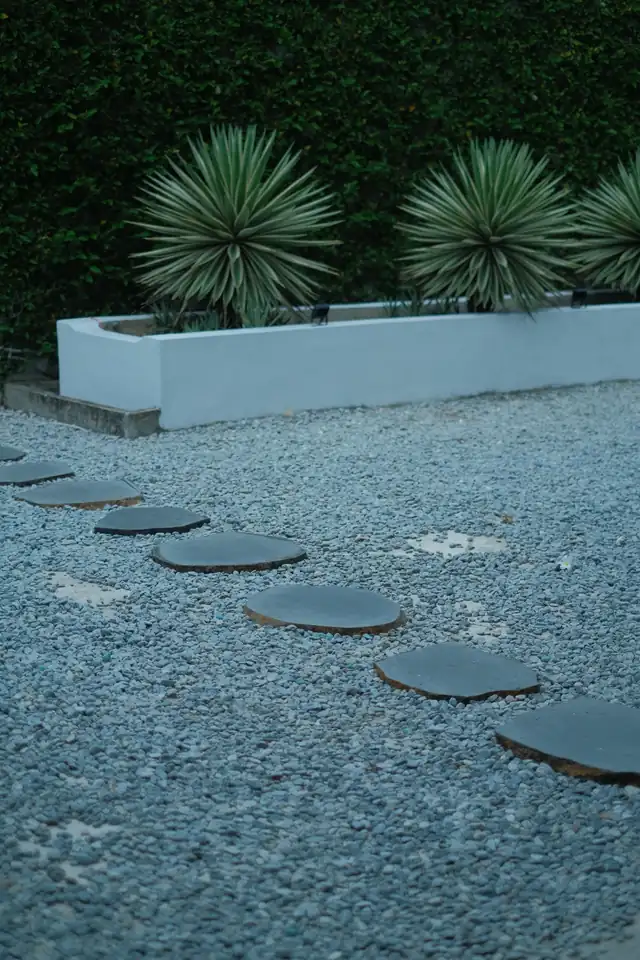
A xeriscape does not have to remove all turf. AgriLife advises confining grass to blocky, squarish areas, because long or oddly shaped turf is hard to water efficiently.[3] It also advises zoning so grass is watered separately and more often than groundcovers, shrubs and trees.[3]
If you keep a lawn, buffalograss is a low-maintenance Central Texas choice for areas with 25 inches of rain or less.[11] It has little shade tolerance.[11] Zoysia is drought tolerant but browns sooner than bermuda in a long drought.[11]
Irrigation in a xeriscape
AgriLife says drip irrigation is more efficient and better for plants than sprinklers.[3] The City of San Marcos runs a water rebate program that includes converting spray zones to drip or point-source emitters.[12] The work must be done by a Texas licensed irrigator or by the property owner.[12] Details are on the city's Water Rebate Programs page. Under Stage 3, as of 2026-11-23, drip and soaker lines get one day per week, before 10 a.m. or after 8 p.m.[1] This site does not arrange irrigation work.
HOA and city rules
Texas law shields water-conserving natural turf and drip systems from HOA bans. The HOA may still ask to review the plan so the design looks compatible with the neighborhood, but it may not unreasonably deny it.[2] It can also require water-conserving turf in new plantings.[2] Keep the written approval on file.
Near a creek or low area, a lot that is not fully two feet above the floodplain can trigger a Floodplain Permit for building work.[13] Walls and raised planters may count.
What xeriscaping costs
One national source (February 2026) lists xeriscaping at $6 to $18 per square foot or more with extensive design plans.[14] That is a national range and the site passes no price of its own. Cost rises with hardscape, imported soil, large plants, drainage work and irrigation. The same publisher's gravel guide (December 2025) lists crushed stone at $1 to $3 per square foot at 12 inches deep.[15]
Plants usually cost less to maintain afterward, but the first year needs watering to establish roots. Ask for a phased plan if you want to spread the cost.
Questions to ask the provider
- Which plants are native or adapted, and how big will they get?
- How is the soil being prepared, and where will water go in a storm?
- What is the irrigation plan, and who installs it? Any sprinkler or drip installation for hire requires a state license.[16]
- How much mulch or rock, and how deep?
- What watering schedule applies during the first year?
Building a xeriscape in phases
Few owners rip everything out at once, and they do not have to. AgriLife says a water-efficient design can be put in gradually over several years.[3] A sensible order looks like this:
- Plan and test. Sketch the yard, mark sun and shade, and send a soil sample to the lab.
- Fix drainage and grade. Water should move away from the house and toward the plants that want it.
- Shrink the lawn. Convert the hardest-to-water strips first, such as side yards and narrow borders.
- Plant the frame. Trees and large shrubs go in first, because they take longest to mature.
- Fill the beds. Add perennials, grasses and groundcovers in groups that share a water need.
- Cover the soil. Spread mulch or stone once the plants are in place.
- Tune the watering. Water each zone to its need, within the city's current limits.
Ask a provider to price each phase separately. That lets you stop after any step without leaving the yard half-finished.
Shrinking the lawn without losing the yard
Turf is the thirstiest part of most yards. AgriLife's Xeriscape guide suggests cutting lawn area by working patios, decks, shrub beds and groundcovers into the design.[3] On slopes, TWDB notes that groundcovers reduce runoff.[10] Whatever grass remains should sit in simple, blocky shapes that are easy to water.
Removing old turf creates a pile of sod and soil. The city's brush drop-off does not take either, so ask the provider where it goes and whether hauling is in the price.[17]
The water numbers behind the idea
Landscape water use is large enough to be worth the effort. AgriLife's guide says that in summer as much as 60 percent of an average household's water may go to landscape maintenance.[3] It also says most lawns receive twice as much water as they need.[3] TWDB says healthy summer turf rarely needs more than 1 inch of water per week.[10]
Plants chosen for the site need less. TWDB says established plants do well in summer on watering about once a week, especially with mulch around them.[10] AgriLife adds that a design built on Xeriscape principles can cut maintenance by as much as 50 percent.[3] Those are state-agency figures for typical conditions, so treat them as direction, not a promise for your lot.
Group plants by thirst
Plan the yard in water zones. A small high-use area near the house can hold the thirsty plants, such as a vegetable bed. Shrubs and perennials form a middle zone. Natives and drought-adapted plants fill the outer zone, where watering can be rare once roots are established. AgriLife's guide recommends watering grass separately from, and more often than, groundcovers, shrubs and trees.[3] TWDB recommends deep, infrequent watering to encourage deep, well-established root systems.[10]
Mulch and stone choices
AgriLife lists organic mulches such as pine bark, compost and woodchips, and inorganic ones such as lava rock and limestone.[3] Both reduce weeds and keep soil temperatures more even.[3] TWDB suggests choosing a mulch made from native sources.[10] Organic mulch improves the soil as it breaks down, while stone lasts longer but adds nothing to the ground. The mulch installation page and the gravel landscaping page compare the two in detail.
Plants that look the part
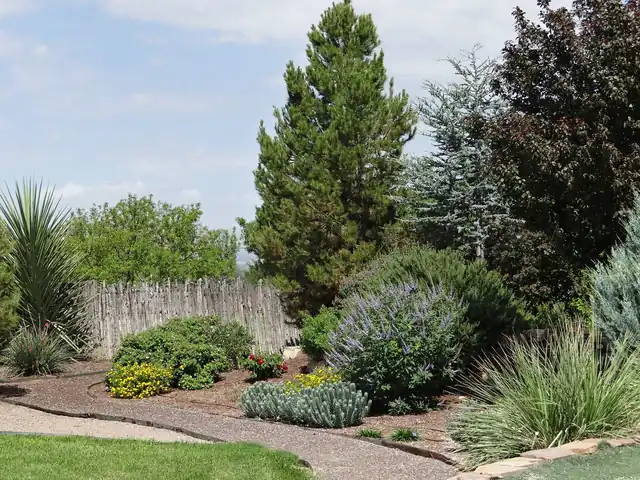
A xeriscape does not have to look sparse. AgriLife describes blackfoot daisy as a maintenance-free native that resists disease and pests and needs almost no water.[8] Fall asters flower in October and November, feeding bees and butterflies late in the year.[8] The xeriscape plant list names more options.
Read the fine print on vigorous natives. AgriLife warns that Maximilian sunflower, Alamo vine and silver sage can take over a bed within a few years when watered and fertilized.[8] Pecan and American elm are native but need regular watering in an ordinary yard, so they are poor fits for a low-water design.[8]
Mistakes that undo a xeriscape
- Replacing the lawn with a sheet of rock and nothing else, which leaves a hot, bare yard.
- Mixing thirsty and drought-adapted plants in one bed, so someone overwaters.
- Skipping the soil test and the sun check.
- Forgetting that new plants still need frequent water while roots develop.
- Laying fabric under stone in planted beds, where debris builds on top and weeds root.
- Choosing plants for their photos and not their mature size.
Care in the first two years and after
Planting is only the start of the water-saving. AgriLife says new trees and shrubs need frequent watering until well rooted, which can take two growing seasons.[3] After that, the schedule thins out. Watch the plants rather than the calendar: TWDB says turf looks dull and dark, and its blades roll, when it needs water.[10] Walk the yard monthly to check for leaks and broken heads, since the city counts those as waste.[1] Trim oaks only outside the oak wilt window,[18] and top up mulch where it has thinned. A local provider can offer a seasonal visit so the yard stays on plan.
Related services
Pair this with landscape design, native plant landscaping, and mulch and flower bed care. The cost guide, local rules and home page have more.
Send a request
Sources
- City of San Marcos. Water & Energy Conservation (Stage 3 watering restrictions), accessed 2026-11-23
- Texas Legislative Council (Texas Constitution and Statutes). Tex. Prop. Code Sec. 202.007 Certain Restrictive Covenants Prohibited, accessed 2026-11-23
- Texas A&M AgriLife Extension (Texas Water Resources Institute irrigation site). E-447 Xeriscape: water-efficient landscaping, accessed 2026-11-23
- NOAA National Centers for Environmental Information. 1991-2020 U.S. Climate Normals, annual/seasonal, San Marcos TX (USC00417983), accessed 2026-11-23
- NOAA National Centers for Environmental Information. 1991-2020 U.S. Climate Normals, monthly, San Marcos TX (USC00417983), accessed 2026-11-23
- phzmapi.org (third-party mirror of USDA plant hardiness zone data). Plant Hardiness Zone Map API, ZIP 78666 (2023 USDA map data), accessed 2026-11-23
- Texas State University (Southwest Texas State University). Soils of the Freeman Ranch, Hays County, Texas (Freeman Ranch Publication Series No. 4-2000), published 2000-07-01
- Texas A&M AgriLife Extension. Native plants for Edwards Plateau landscapes, published 2023-03-01
- Texas A&M AgriLife Extension. E-436 Fertilizing Texas Lawns: 10-Point Checklist for Warm-Season Grasses, published 2007-01-01
- Texas Water Development Board. Texas Landscape Water Guide, accessed 2026-11-23
- Texas A&M AgriLife Extension. Turfgrass Selection for Texas (L-5519), published 2010-06-01
- City of San Marcos. Water Rebate Programs, accessed 2026-11-23
- City of San Marcos. FAQs, Engineering Department - Development (floodplain), accessed 2026-11-23
- HomeGuide. How Much Does Landscaping Cost?, published 2026-02-04
- HomeGuide. How Much Does Crushed Stone or Gravel Cost?, published 2025-12-19
- Texas Commission on Environmental Quality. RG-470 Landscape Irrigator's Rule Compilation (Feb 2021), published 2021-02-01
- City of San Marcos. San Marcos Monthly Brush Drop-Off Event, accessed 2026-11-23
- Texas A&M Forest Service. Prevent the spread of oak wilt this spring in Texas, published 2022-03-29