On this page (7 sections)
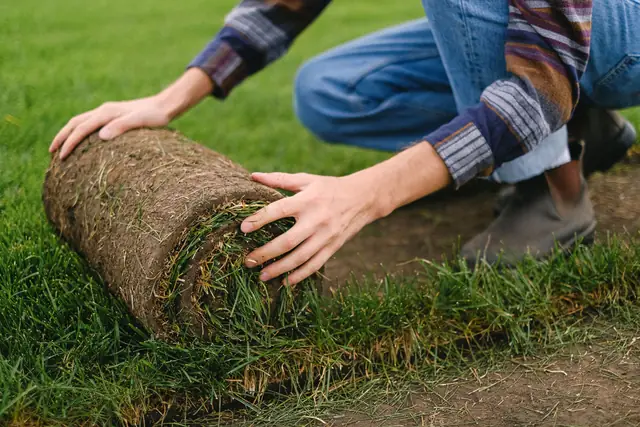
What does sod cost per square foot?
A national cost guide's October 2025 range for installed sod is $1.00 to $2.00 per square foot for a new lawn, and $1.50 to $4.00 when old turf is removed.[1] These are national figures, not San Marcos prices.
The published sod price ranges
Sod prices come in two forms: material alone, and material plus labor. Mixing them up is the easiest way to think a bid is a bargain or a rip-off.
| Item | Range | Unit |
|---|---|---|
| Installed sod, new lawn[1] | $1.00 to $2.00 | per square foot |
| Installed sod, old lawn removed and resodded[1] | $1.50 to $4.00 | per square foot |
| St. Augustine sod, material[1] | $0.30 to $0.80 | per square foot |
| Bermuda sod, material[1] | $0.30 to $0.85 | per square foot |
The material rows are the grass itself. The installed rows add the work around it. Seeding is the budget alternative on another national price table at $0.04 to $0.18 per square foot, though seed is slower and not suited to every grass.[2] The landscaping cost page puts sod next to every other service range.
What the installed price pays for
When a provider writes a sod price, several jobs are bundled into it. Ask for each to be named.
- Removal. Clearing the old lawn or weeds is why the old-lawn row costs more.
- Grading. The same guide lists yard grading separately at $0.40 to $2.00 per square foot, so check whether leveling is in the sod price or added on.[2]
- Soil work. The Texas Water Development Board suggests blending topsoil with about 25 percent compost for a new lawn, starting with a soil test.[3]
- Delivery and laying. Fresh sod is perishable, so it is laid soon after it arrives.
- Cleanup. Leftover scraps and old turf need to go somewhere.
A very low price per square foot often means one or more of these is missing. That is not always bad, but you should know which.
Which grass changes the bill
The grass species matters for cost, for water and for how the lawn behaves in a drought. AgriLife Extension says choosing turf means picking both a species adapted to your climate and a variety, based on shade or sun, soil depth, traffic and irrigation.[4]
St. Augustine
AgriLife says it is the most shade-tolerant warm-season turf but is less drought tolerant than bermudagrass or zoysiagrass.[4] It can be grown in Central Texas with more supplemental irrigation and is established from sod.[4] The Texas Water Development Board says it needs at least 35 inches of rain a year.[3] San Marcos averages 36.55 inches, according to NOAA's 1991 to 2020 normals, which is right at the edge.[5]
Bermuda
AgriLife says bermudagrass is grown throughout Texas, tolerates drought and traffic, and needs full sunlight.[4] The TWDB says Bermuda and zoysia thrive in 25 to 35 inches of rainfall.[3]
Zoysia
AgriLife says zoysiagrass is drought tolerant but tends to turn brown sooner than bermudagrass in an extended drought, and it is best established from sod.[4]
Buffalograss
AgriLife says buffalograss does well as a low-maintenance lawn from Central to West Texas but has little shade tolerance.[4] It is best adapted to areas getting 25 inches of rain a year or less and is easily invaded by weeds if watered excessively.[4] AgriLife lists both sod varieties and seeded varieties, so ask what is available.
The price gap between grasses is small on the material rows above. The real difference shows up later, in water use and in how the grass handles a drought stage.
San Marcos factors that raise or lower the cost
Watering limits. New sod needs steady water for its first weeks. Drought stages are watering-limit levels that tighten as aquifer or lake levels drop. As of November 2026, the city page listed Stage 3 limits: sprinklers one day every other week, before 10 a.m. or after 8 p.m.[6] Hand-held hose or bucket watering was allowed any day in those hours.[6] The same page lists no separate exemption for newly installed residential sod.[6] A provider may add hand-watering visits or advise waiting, and either changes the real cost.
Soil. A Texas State University publication says Edwards Plateau soils in Hays County are mostly stony and sit on erosion-resistant limestone.[7] One Hays County map unit is mostly extremely stony clay with limestone about 13 to 20 inches down, below the surface layers.[7] Sod roots need depth. Thin soil over rock either needs added topsoil or a grass and watering plan that accepts a thinner lawn.
Shape and size. AgriLife advises confining grass to blocky, squarish areas, since long, narrow or oddly shaped turf is hard to water efficiently.[8] Cutting narrow strips from the plan saves sod, water and labor.
Timing. Hot, dry weeks stress new turf. NOAA's normals show about 21.4 days a year at 100 F or more in San Marcos.[5] Ask the provider when it would lay sod and what happens if a stage tightens during establishment.
Questions to ask before you accept a sod price
- Is the price per square foot, per pallet or per job?
- Does it include removal of the old lawn, grading and soil preparation?
- Which grass species and variety, and why does it suit my sun and soil?
- What watering schedule does the provider expect, and how does it fit the current drought stage?
- What happens if sod fails to root?
The Texas Attorney General advises getting bids from more than one contractor, in writing, with detail on what will be done.[9] Matching those five answers across bids is how you compare them fairly.
A cheaper lawn is not always the lower cost
Sod costs more up front than seed, but it covers the ground at once and cuts erosion and weeds while it roots. A lawn that needs less water also costs less to keep through a Stage 3 summer. AgriLife says the greatest water waste in a landscape is applying too much too often.[8]
For the full service description, see the sod installation page. For mowing and upkeep afterward, see the lawn care page. For rules that affect watering, see local rules, and for more short answers, return to the questions page.
Send a request
Sources
- HomeGuide. How Much Does Sod Installation Cost?, published 2025-10-31
- HomeGuide. How Much Does Landscaping Cost?, published 2026-02-04
- Texas Water Development Board. Texas Landscape Water Guide, accessed 2026-11-23
- Texas A&M AgriLife Extension. Turfgrass Selection for Texas (L-5519), published 2010-06-01
- NOAA National Centers for Environmental Information. 1991-2020 U.S. Climate Normals, annual/seasonal, San Marcos TX (USC00417983), accessed 2026-11-23
- City of San Marcos. Water & Energy Conservation (Stage 3 watering restrictions), accessed 2026-11-23
- Texas State University (Southwest Texas State University). Soils of the Freeman Ranch, Hays County, Texas (Freeman Ranch Publication Series No. 4-2000), published 2000-07-01
- Texas A&M AgriLife Extension (Texas Water Resources Institute irrigation site). E-447 Xeriscape: water-efficient landscaping, accessed 2026-11-23
- Office of the Texas Attorney General. How to avoid home improvement scams, accessed 2026-11-23