On this page (6 sections)

Which grass needs the least water in San Marcos?
AgriLife calls buffalograss a low-maintenance lawn for Central to West Texas, though it tolerates little shade.[2] TWDB suits it to areas with 15 to 25 inches of rain, while San Marcos averages 36.55 inches, and ties bermuda and zoysia to 25 to 35 inches.[1][3]
Start with the three questions
Before comparing grasses, answer these about your yard:
- How much sun does the lawn get? Most warm-season turf needs full sun.
- How much water will you apply? Stage limits can cap you at one day a week.
- Who walks on it? Dogs, kids and mowers all count as traffic.
The Texas Water Development Board adds a rainfall screen. Bermuda and zoysia thrive in 25 to 35 inches a year, St. Augustine needs at least 35, and buffalo and native grasses suit 15 to 25.[1] NOAA normals put the local station at 36.55 inches, with July at only 2.21.[3][4] That is enough for the first three on paper, but summers are dry and hot, with 21.4 days at 100 F or more.[3]
Grass by grass
| Grass | Strength | Weak point | Mowing height |
|---|---|---|---|
| St. Augustine | Most shade tolerant warm-season turf | Less drought tolerant; needs more irrigation | 2.5 to 4 inches[5] |
| Bermuda | Drought and traffic tolerant | Needs full sun | Common 1 to 3; hybrid 0.75 to 2 |
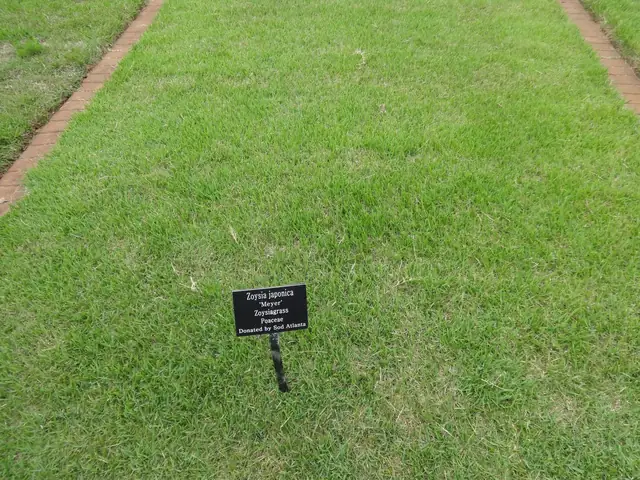
| Zoysia | Drought tolerant | Browns sooner than bermuda in long drought | 1 to 2 inches (Z. japonica)[2] |
| Buffalograss | Low maintenance | Little shade tolerance; weeds if overwatered | Not listed in the sources used |
St. Augustine
AgriLife says St. Augustinegrass is the most shade-tolerant warm-season turf but less drought tolerant than bermuda or zoysia.[2] It can grow in Central Texas with more supplemental irrigation and is established from sod.[2] Choose it for a shaded yard where you can water, not for a sunny yard under a one-day limit.
Bermudagrass
Bermuda is grown throughout Texas, tolerates drought and traffic, and needs full sunlight.[2] That makes it a common pick for open front yards and play areas. An AgriLife mowing chart written for East Texas gives common bermuda 1 to 3 inches, optimal at 1.5, and hybrid bermuda 0.75 to 2 inches, optimal at 1.[5] Cut too high and it thins.
Zoysia
Zoysiagrass is drought tolerant but turns brown sooner than bermuda in an extended drought, and is best established from sod.[2] The same publication lists Z. japonica zoysia mowing at 1 to 2 inches, versus 1 inch or less for fine-bladed Z. matrella types.[2] Zoysia sits in the middle: more drought tolerant than St. Augustine, quicker to brown than bermuda in a long drought.
Buffalograss
Buffalograss does well as a low-maintenance lawn from Central to West Texas but has little shade tolerance.[2] It is best adapted to areas with 25 inches of rain a year or less and is easily invaded by weeds if watered excessively.[2] Its appeal is saving water and mowing. Its risk is looking thin if you treat it like a St. Augustine lawn.
Not sure which grass fits your sun and water?
Calls will be recorded.
Soil and water limits narrow the list
Local ground is often stony over limestone, and some Hays County soils are heavy clay with very slow permeability.[6] Thin stony soil favors a grass that tolerates drying, and heavy clay favors one that copes with cracking in dry spells. A grass that needs frequent irrigation also fits poorly under a one-day-a-week drought stage, so the drought-tolerant species rank higher on a restricted yard. The watering guide lists the current San Marcos limits, and the planting-time article covers when to lay or seed.
Shape matters too. AgriLife advises confining grass to blocky, squarish areas, because long or oddly shaped turf is hard to water efficiently.[7] If part of a yard cannot be watered well, a xeriscape bed or gravel may suit it better than lawn.
Mowing and care once it grows
- Mow at the height listed for your grass and never remove more than a third of the blade at once.
- Soak deeply rather than watering often and shallow; an AgriLife lawn calendar written for East Texas puts the target at four inches.[5]
- Check sprinkler heads each month and fix any that spray hard surfaces.
See lawn care for ongoing work. The seasonal yard calendar shows when each task lands.
Which one should you pick?
- Shaded yard with irrigation you can use: St. Augustine.
- Sunny, busy yard: bermuda.
- Moderate sun and a wish for a finer look: zoysia.
- Low water use, full sun and little foot traffic: buffalograss.
Prices for sod and installation are national ranges on the landscaping cost page, and HOA and license rules are on the local rules page.
Send a request
Sources
- Texas Water Development Board. Texas Landscape Water Guide, accessed 2026-11-23
- Texas A&M AgriLife Extension. Turfgrass Selection for Texas (L-5519), published 2010-06-01
- NOAA National Centers for Environmental Information. 1991-2020 U.S. Climate Normals, annual/seasonal, San Marcos TX (USC00417983), accessed 2026-11-23
- NOAA National Centers for Environmental Information. 1991-2020 U.S. Climate Normals, monthly, San Marcos TX (USC00417983), accessed 2026-11-23
- Texas A&M AgriLife Extension. Lawn Maintenance Guide, accessed 2026-11-23
- Texas State University (Southwest Texas State University). Soils of the Freeman Ranch, Hays County, Texas (Freeman Ranch Publication Series No. 4-2000), published 2000-07-01
- Texas A&M AgriLife Extension (Texas Water Resources Institute irrigation site). E-447 Xeriscape: water-efficient landscaping, accessed 2026-11-23