On this page (8 sections)
Is fall or spring better for planting grass?
Neither is perfect. Warm-season grass roots best between the last freeze and peak heat, and NOAA shows about 19.8 freezing nights a year and 21.4 days at 100 F or more.[1] Pick a window that avoids both, and check the current watering stage first.
What the San Marcos climate record shows
NOAA's 1991 to 2020 normals for the San Marcos station give a clear picture of the planting window.
| Measure | Normal | Why it matters for planting |
|---|---|---|
| Annual precipitation | 36.55 in[1] | Moderate rain, but it arrives unevenly |
| Nights at or below 32 F | 19.8 a year[1] | Frost ends the growing season for warm-season grass |
| Days at 100 F or more | 21.4 a year[1] | Peak heat stresses new roots |
| August normal high | 96.8 F, with 10.6 days at 100 F or more[2] | The hardest month for establishment |
| Growing degree days (base 65 F) | 2,973.7 a year[1] | A measure of how much warm-season grass can grow |
January averages a high of 62.3 F and a low of 38.9 F, with 6.9 nights at or below 32 F; December has 5.6 such nights and February 4.4.[2] Warm-season grass is not growing in that stretch. A USDA-based hardiness lookup puts ZIP 78666 in zone 9a, with an average annual extreme minimum of 20 to 25 F.[3]
Rain month by month
New grass needs moisture, so the rain calendar helps. May is the wettest month at 4.53 inches, followed by October at 4.41 and September at 4.03.[2] July is 2.21 inches and February 1.73.[2] Summer rainfall for June through August is about 3.57, 2.21 and 2.60 inches, against highs of 92 to 97 F.[2]
Rain normals are averages. They do not promise a wet week when you need one. Plan to water by hand or with drip only if the current stage allows it.
Matching the grass to the season
Warm-season sod: St. Augustine, Bermuda, zoysia
These are the common lawn grasses here, and AgriLife says St. Augustine and zoysia are best established from sod, so their window is the sod window.[4] Warm-season grass grows with warm soil and air. Planting after the last spring frost and before midsummer heat gives roots weeks of growth without peak stress. This is general lawn-care practice, so confirm the date with the provider you hire.
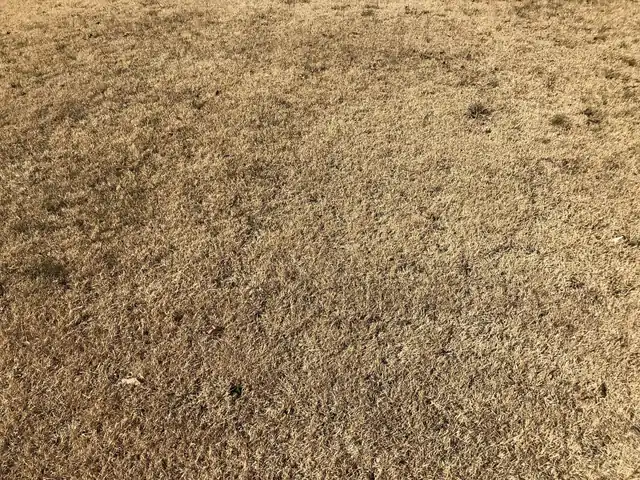
Warm-season grasses turn straw-colored at the first frost and may go dormant in winter.[4] Laying sod in late fall means it sits dormant, which slows rooting.
Seeded lawns
A seeded lawn needs warm soil to sprout and steady moisture until it fills in, so the same spring window applies. Which species to seed or sod is a separate question, covered in the grass choice guide.
Winter ryegrass overseed
If you want green in winter, AgriLife says ryegrass can be overseeded into bermudagrass in late September and October for winter color.[4] That is a color treatment on top of an established lawn, not a way to start a new one.
Why the drought stage can override the calendar
The best planting weather means little if watering is restricted. A drought stage is a watering-limit level that tightens as aquifer or lake levels drop. As of November 2026 the city page says San Marcos is in Stage 3, which allows sprinklers only one day every other week, before 10 a.m. or after 8 p.m. on the designated weekday.[5] Drip and soaker hose were allowed one day per week on that weekday, in the same hours.[5]
The same page lists no separate exemption for newly installed residential sod.[5] That is why many people wait for a lower stage before laying a large lawn. The city's conservation page shows the current stage, and the local rules page explains each limit.
The Edwards Aquifer Authority runs its own stages. Its page, updated 22 November 2026, showed the San Antonio Pool in Stage 2 with a 30 percent reduction.[6] The city can be in a different stage from the aquifer authority, so check both.
Steps before you plant
- Test the soil. The Texas Water Development Board calls a soil test the number one key to establishing and maintaining landscape plants.[7]
- Improve thin or heavy soil. For a new lawn, the board suggests blending topsoil with about 25 percent compost.[7] Edwards Plateau soils in Hays County are mostly stony over limestone,[8] so depth matters.
- Pick the grass for the site. Shade, traffic and irrigation help decide it.[4]
- Check the stage. If watering is restricted, ask the provider how they would establish the lawn.
- Water the right way. The best time to water is early morning or late evening, when wind is calmer and evaporation lower.[7]
Fall and winter planting: trees and shrubs, not turf
Cooler months suit trees and shrubs better than warm-season grass, because roots grow while the top stays quiet. For oaks, remember that the Texas A&M Forest Service advises avoiding pruning or wounding them from February through June.[9] Read the tree and shrub planting page for the details.
What to do next
For grass types and installed prices, see the sod installation page and the article on how much sod costs. For mowing and feeding after planting, see the lawn care page. More short answers are on the questions page.
Send a request
Sources
- NOAA National Centers for Environmental Information. 1991-2020 U.S. Climate Normals, annual/seasonal, San Marcos TX (USC00417983), accessed 2026-11-23
- NOAA National Centers for Environmental Information. 1991-2020 U.S. Climate Normals, monthly, San Marcos TX (USC00417983), accessed 2026-11-23
- phzmapi.org (third-party mirror of USDA plant hardiness zone data). Plant Hardiness Zone Map API, ZIP 78666 (2023 USDA map data), accessed 2026-11-23
- Texas A&M AgriLife Extension. Turfgrass Selection for Texas (L-5519), published 2010-06-01
- City of San Marcos. Water & Energy Conservation (Stage 3 watering restrictions), accessed 2026-11-23
- Edwards Aquifer Authority. Critical Period/Drought Management (CPM), published 2026-11-22
- Texas Water Development Board. Texas Landscape Water Guide, accessed 2026-11-23
- Texas State University (Southwest Texas State University). Soils of the Freeman Ranch, Hays County, Texas (Freeman Ranch Publication Series No. 4-2000), published 2000-07-01
- Texas A&M Forest Service. Prevent the spread of oak wilt this spring in Texas, published 2022-03-29