On this page (6 sections)

How Buda's stage is decided
Buda does not pick its stage alone. A city ordinance moves it to Stage 3 when two or more of its water suppliers do. Those suppliers are the Barton Springs/Edwards Aquifer Conservation District and the Guadalupe-Blanco River Authority.[1] The city said its residents had to observe Stage 3 from 4 November 2024.[1]
The district's own status page, read on 23 November 2026, listed Stage 3 Exceptional Drought in effect since 1 October 2025. It showed Barton Springs at a 10-day average of 15 cubic feet per second (the page's last update was 12 November 2026).[2] The city's notice describes the 2024 change, so check both pages for today's stage before you plan new turf or a new planting.
Watering days and hours
| Address type | Stage 3 day |
|---|---|
| Odd-numbered residential | Wednesday |
| Even-numbered residential | Thursday |
| Commercial, mixed use, multi-family | Tuesday |
Hours are 7 to 11 a.m. or 7 to 11 p.m.[1] The page also lists Stage 4 as watering once every other week in the same two windows.[1] That is a useful reminder to design for the worst case. San Marcos uses a different system. Sprinklers run one day every other week, and watering is allowed before 10 a.m. or after 8 p.m.,[3] so a provider who works in both towns needs your exact address. See the San Marcos rules for comparison.
Variances for new work
Buda offers a drought variance request form that covers new landscape irrigation, pools and power washing.[1] Ask the city whether a variance applies to a new planting. Do not water a new planting on an off day and hope the rule is relaxed.
Texas requires a state license to install or service an irrigation system. An owner may do irrigation work on his or her own home premises.[4]
Trees: size classes and mitigation
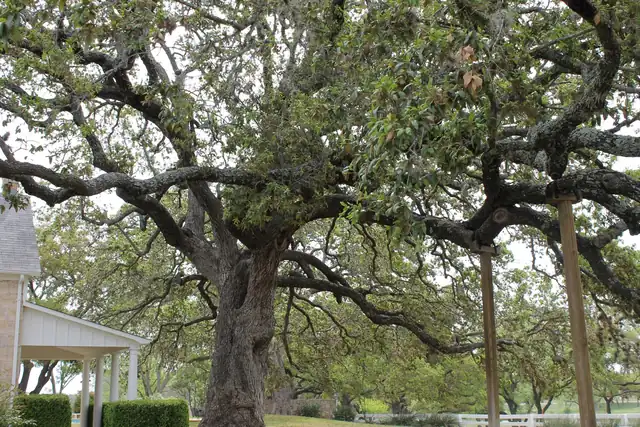
Buda sorts trees by trunk size. A December 2019 local newspaper report on the council's tree ordinance lists protected trees at 8 to 20 caliper inches. It puts signature trees at 20 to 30 and heritage trees above 30. Removal must be mitigated at 1:1, 3:1 and 4:1, and each replacement tree must measure 5 caliper inches.[5]
The same report says the council approved its application for a national tree-city designation and that development applications must include a Tree Preservation Plan.[5] That is aimed at builders, but it matters if you are clearing a lot before landscaping. The report is more than six years old, so ask the city what applies to your parcel today.
When trees stay, protect their roots. The City of San Marcos tree-protection specification places fences typically at the outer limit of the critical root zone. It warns against grade changes greater than 4 inches.[6] Buda's own rule may differ, but the root-zone idea is sound anywhere. Read the guide on oak wilt and pruning and the tree and shrub planting page before cutting.
Expansive clay and the foundation
An Austin TV station reported in December 2025 on sinking homes in the city of Kyle and Buda. Experts it quoted said expansive clays are common east of I-35, though the worst problems are scattered.[7] A Buda homeowner told the station she spent $20,000 on 16 concrete and steel supports. She said there is no homeowner's insurance or warranty that covers foundation issues.[7] That is one owner's experience, so check your own policy.
The Texas state soil shows how such clays behave. USDA and the Texas Water Development Board describe Houston Black clay as a Blackland Prairie soil. They say water enters it rapidly when dry and cracked but very slowly when moist.[8] That is an illustration, not a description of any Buda lot, because soils vary lot by lot.
Yard steps that follow from this:
- Direct roof water away from the slab, and grade soil to fall away from the house.
- Use steady, slow soaker or drip watering rather than heavy soaks on cracked ground.
- Mulch beds so the soil dries and cracks less.
- Look up your lot's soil type on the online Web Soil Survey tool that the report mentions.[7]
Plants and turf that suit the setting
Clay holds water longer than limestone soil, so drainage matters more than extra irrigation. Choose plants tolerant of both wet and dry spells, and keep turf to small, squarish areas that are easy to water.[9] Bermuda tolerates drought and traffic but needs full sun, while buffalograss suits places with 25 inches of rain or less.[10] See sod installation and the grass guide.
Texas law also protects drought-resistant landscaping from HOA bans, though an HOA can ask for plan review.[11] Keep any approval in writing.
Related pages
Prices are on the landscaping cost page. For neighbors, see Kyle and Wimberley, the nearby areas hub, and the home page.
Send a request
Sources
- City of Buda. Water Conservation, accessed 2026-11-23
- Barton Springs/Edwards Aquifer Conservation District. Drought Status, accessed 2026-11-23
- City of San Marcos. Water & Energy Conservation (Stage 3 watering restrictions), accessed 2026-11-23
- Texas Commission on Environmental Quality. RG-470 Landscape Irrigator's Rule Compilation (Feb 2021), published 2021-02-01
- Hays Free Press. Buda approves new tree ordinance, published 2019-12-11
- City of San Marcos. Item 610S Preservation of Trees and Other Vegetation, published 2018-12-07
- FOX 7 Austin. Experts weigh in on home foundation issues in Central Texas, published 2025-12-30
- Texas Water Development Board / USDA. Houston Black: Texas State Soil, accessed 2026-11-23
- Texas A&M AgriLife Extension (Texas Water Resources Institute irrigation site). E-447 Xeriscape: water-efficient landscaping, accessed 2026-11-23
- Texas A&M AgriLife Extension. Turfgrass Selection for Texas (L-5519), published 2010-06-01
- Texas Legislative Council (Texas Constitution and Statutes). Tex. Prop. Code Sec. 202.007 Certain Restrictive Covenants Prohibited, accessed 2026-11-23