On this page (5 sections)

Path and accent lighting: what the ordinance says
The city links its dark-sky community designation to enforcement of its outdoor lighting ordinance.[2] Article 4.09 covers any fixture installed in the city, including municipal streetlights, so a yard design has to meet it.[1] The copy of the article read for this page was hosted by a regional nonprofit, not the city, so confirm the current text with the city.
Here are the limits that touch a yard:
- Shielding. A fixture over 1,500 initial lumens must confine its light below a horizontal plane and hide the bulb from any point off the property.[1]
- Color. No fixture may use a lamp above 3000 Kelvins, which rules out the bluish, cool-white "daylight" bulbs.[1]
- Total output. Unshielded or nonconforming fixtures together may not exceed 7,200 initial lumens on a property.[1] For nonresidential property in districts RA, R-1 to R-5, MF-1, MF-2 and NS, the article also caps total output at 20,000 initial lumens per net acre and unshielded output at 6,000.[1]
- Brightness. In districts RA, R-1 to R-5, MF-1, MF-2 and NS, no surface may receive more than six footcandles. Light above 0.1 footcandle on a residential neighbor counts as trespass.[1]
- String lights. A light string that does not conform must be removed or have bulbs removed until it does; the article treats seasonal holiday strings separately.[1] Decorative strings shown during the holiday period, November 1 to January 15, are exempt.[1]
Failure to correct a duly noticed violation is punishable by a fine for each day after 30 days following the notice.[1]
Local note
Aim path lights downward, pick warm lamps, and keep each fixture small. Ask the provider to state the lumens and Kelvin rating of every fixture in writing.
Creeks, buffers and what you can plant
The Blanco River and Cypress Creek shape many lots here. The city's water quality article, Article 9.04, sets water quality buffer zones along streams when land is platted. They extend up to 300 feet on each side of the stream centerline, depending on the size of the drainage area.[3] Inside a buffer, landscaping activities are prohibited without the city engineer's written approval. Maintaining native, non-invasive vegetation is among the activities the city may allow.[3]
Two caveats apply. Buffers do not reach lots platted before the ordinance took effect.[3] Single-family homes on existing platted lots are also exempt from its main requirements.[3] Ask the city whether your lot is covered before you plan a wall, patio or regrade.
Hard surfaces count against you. The article counts driveways and walkways as impervious cover but does not count landscaped areas or areas left in their natural state.[3] Ask the city how a patio, gravel path or wall would be counted before you plan one. See rock and gravel landscaping for the material side.
The same article says a developer shall minimize herbicide, pesticide and fertilizer use to the maximum extent practical. It adds that yard waste may not wash into the stormwater system beyond what normally runs off in rain.[3] Bag or compost clippings rather than blowing them toward a ditch.
Planting by the water
The city's stewardship page explains that riparian vegetation slows floodwater and filters runoff. It suggests limiting mowing along the riverbank and removing invasive species.[2] It also recommends native plants because they support wildlife and need less water.[2] See native plant landscaping and the xeriscape plant list.
Oak wilt: when not to cut
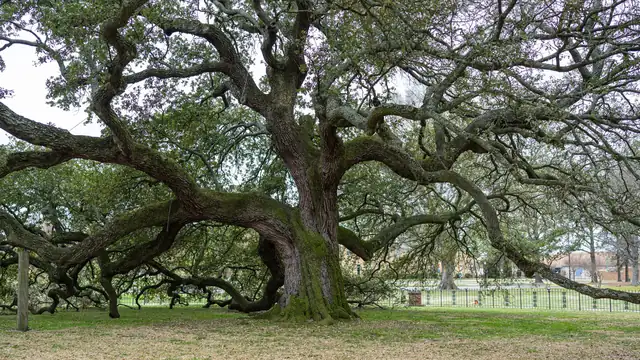
Wimberley warns that trimming oaks can spread oak wilt. Beetles carry the fungus to wounded or freshly pruned trees.[2] The city's stewardship page advises not pruning oaks from February through June.[2]
State guidance agrees: Texas A&M Forest Service says to avoid pruning or wounding oaks from February through June. It also says live oaks pass the disease through connected roots.[4] Before anyone trenches for lighting wire near an oak, ask how roots will be protected. Full detail is in the guide on when to prune live oaks and the tree and shrub planting page.
Planning lights, beds or a tree near a creek?
Calls will be recorded.
Water: wells, aquifers and drought
Some yards here depend on groundwater or a small utility, so the stage that matters depends on your provider. The Hays Trinity Groundwater Conservation District's page, read on 23 November 2026, said it was in an Emergency Drought Stage. It listed a 40% pumping curtailment district-wide and 30% in the Jacob's Well zone.[5]
Jacob's Well is one trigger. As of 25 November 2026 the district listed a 10-day mean flow of 0.298 cubic feet per second, and its Emergency trigger is 3.[5] Those are pumping limits on permit holders, not a household watering schedule, so ask your own water provider for yard rules.
Practical steps that fit this setting:
Cost, rules and nearby towns
National price ranges are on the landscaping cost page, and licensing is on the local rules page. Neighbors with different rules include the city of Kyle and Buda; the nearby areas hub and home page link the rest.
Send a request
Sources
- City of Wimberley. Article 4.09 Outdoor Lighting (Wimberley code, copy hosted by Hill Country Alliance), accessed 2026-11-23
- City of Wimberley. Environmental Stewardship, accessed 2026-11-23
- City of Wimberley. Wimberley Code of Ordinances, Article 9.04 Water Quality Protection (reproduced by Zoneomics), accessed 2026-11-23
- Texas A&M Forest Service. Prevent the spread of oak wilt this spring in Texas, published 2022-03-29
- Hays Trinity Groundwater Conservation District. Drought Management, accessed 2026-11-23
- Texas Water Development Board. Texas Landscape Water Guide, accessed 2026-11-23
- Texas State University (Southwest Texas State University). Soils of the Freeman Ranch, Hays County, Texas (Freeman Ranch Publication Series No. 4-2000), published 2000-07-01